
- May 28, 2026
- 1:43 pm
Rama, History, Divinity, Philosophy and Religion - Part 1
1.0 Preamble
Recently Rahul Gandhi in his talk in abroad described Rama as a mythological and Pauranik character. This was enough to infuriate a section of orthodox Hindu and a court case has been filed against him; to send him to Jail for sealing his political career, charging him for hurting the belief and faith of Hindus. Honesty of Indian judiciary is apparent and expecting justice is like living in fool’s paradise. However, a known ghost is less imperileious than an unknown ghost. A Rahul free from political obligations may prove devastating for RSS and BJP. The over confidence of having annihilated Buddhism from India ie Santana philosophy may turn out to be vacuous and jeopardious.
It should be understood very clearly that Rahul was talking on historical reality wherein paradigm of mere faith, belief or religiosity has no place at all to a logical mind. Belief and faith has no rational and scientific back up and if anyone feels that his religious feeling has been hurt he should himself first determine within himself if Rama is God or human, spiritual or historical, real or mythical. If Rama was human, he can’t be God. If he was divine, he can’t be historical. No archeological proof has been found to substantiate the existence of Rama as a real historical character from several archeological excavations in and around Ayodhya, the so called city of Rama.
2.0 Rama In Literature
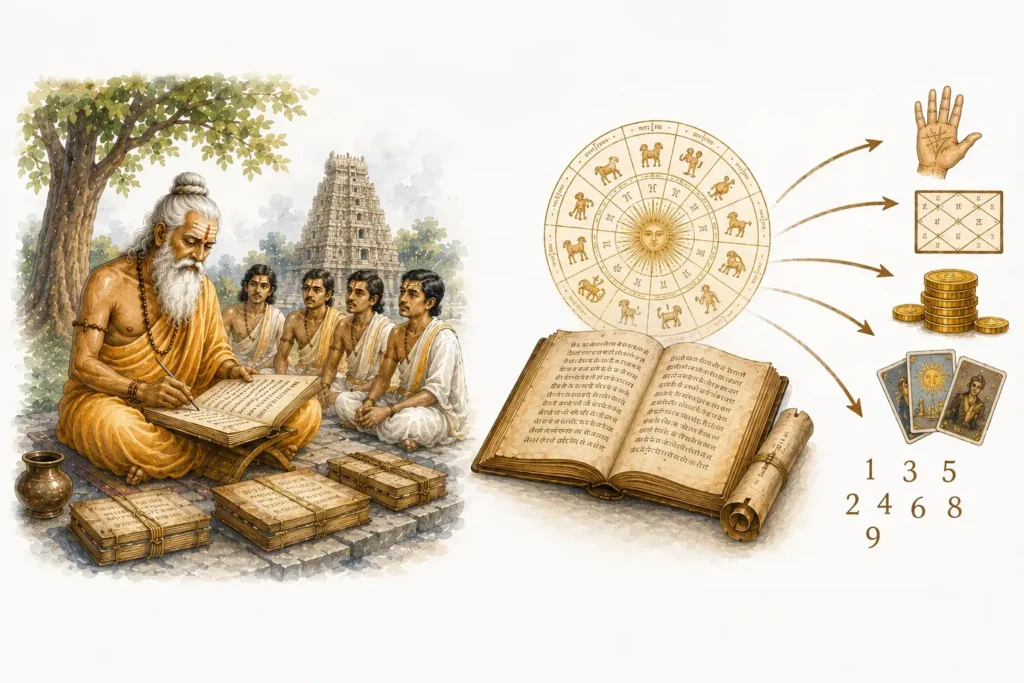
Although no concrete historical evidences of Rama is available his stories; despite being inconsistent and also at times in variance, has been invariably mentioned in different Hindu scriptures. This gives an impression that he was a figure in far fadding past of human history whose features and qualities have been exaggerated with poetic imaginations.
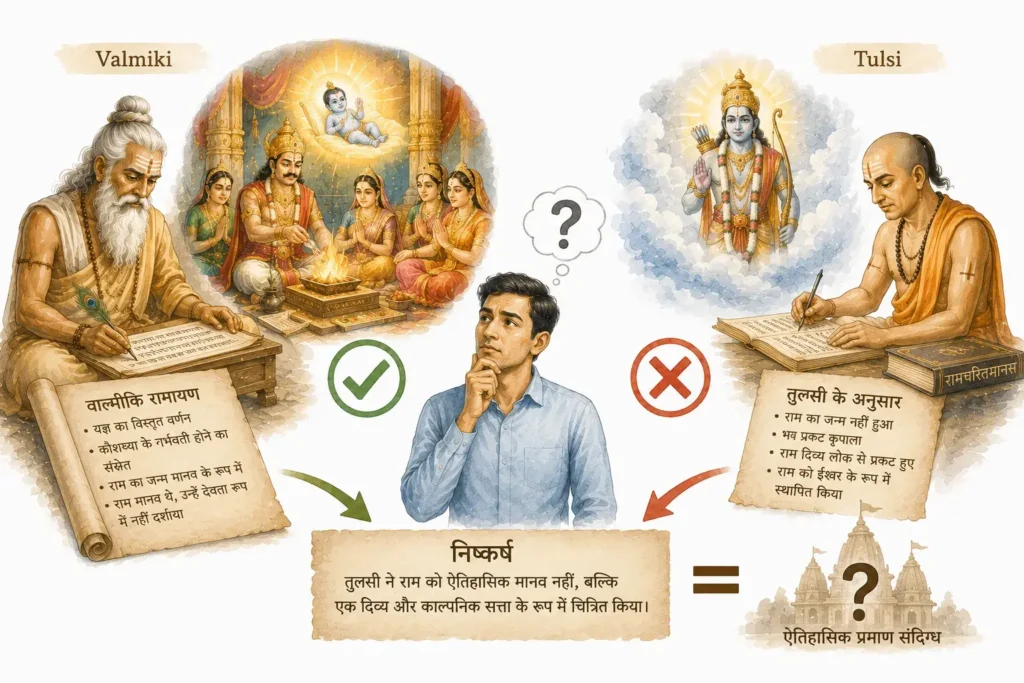
The principal texts containing story of Rama that can be taken here for our thoughtful discussion are Ramayana of Valmiki and Ram Charit Manas of Tulsi Dasa. While Valmiki doesn’t depict Rama as God, Tulsi describes him as all mighty God and this concept has been spread in general public in India by the story tellers (कथा वाचक,) and Sadhu community. But description of Tulsi Dasa itself implies that Rama is a hypothetical figure and it is merely a fictional story. Let us take following instances
2.1. In the beginning of his Ramayana Tulsi narates the discussion between Bharadwaj Rishi and Yaagyavalka. There Bhardwaj implores Yaagyavalka, “There have been many Rama amongst which son of Dasarath is also called one of the Rama. But O learned sage, kindly tell me what is really Rama?”
We gather two things from this description
2.1.1 Sage Bhardwaj is not the least interested in Rama who is said to be the son of king Dasarath. He is interested in Rama element (राम तत्व). This indicates that Rama , the son of Dasarath, is of nil spiritual significance (आध्यात्मिक महत्व). So, if Tulsi has endeavoured to foist divinity upon Rama is a forcedly engendered effort. Here, Tulsi inadvertently agrees with Valmiki who considers Rama as a human being of some superior quality but not the God almighty.
2.1.2 There have been many persons named Rama but none of them were of any spiritual or meditative relevance. Son of Dasarath called Rama was also an ordinary human being only. Hence, he is not of any religious value.
2.2. Tulsi writes that the story of Rama was fabricated in the mind of Shiva who later narrated it to his consort Parawati – रचि महेश निज मानस राखा, पाय सुसमय उमा सन भाखा। Now a story which is woven in somebody’s mind is a fiction and can’t be the history. As such, Tulsi indirectly confesses here that the story of his book is a fictional one. So it’s hero can’t be a historical character.
2.3. While Valmiki gives exhaustive description of Yajna performed before birth of Rama and a concealed idea of , how Kaushlya became pregnant, Tulsi tells that Rama didn’t come from the womb but he appeared from cosmic ethereal realms- भय प्रगट कृपाला. Here Tulsi clearly denies birth of Rama and strives to potrait him as God. Thus, the real identity of Rama as human being after taking conventional birth is not supported by Tulsi. Through out his book Tulsi can be seen struggling to establish Rama as supreme personality of Godhead.
2.4. Tulsi as a token of repentance for having committed something wrong further confesses – Despite knowing that you are supreme being, without birth, inexplicable and inexpressible, unknowable, can be perceived only through mind, I have described you as a person normal human form (in my story). – जे ब्रम्ह अजमव्यक्तमनुभवगम्य मन पर ध्यावही, ते कहहूं जानहुं नाथ हम तब सगुण यश नित गावही। In this way he has accepted that Rama is not human; albeit, he has described him as human superimposing upon him the features of Supreme personality of Godhead.
From all these accounts Tulsi has again and again accepted that Rama; the son of Dasarath, whose story he has indited, is only a hypothetical and mythological entity.
3.0 Historical Aspects
3.1 In Valmiki Ramayana and other relevant texts viz Raghuvanshama etc pedigree of Rama is given which casts an impression that Rama was perhaps an important figure in very very ancient human history whose tales are being transferred from generation to generation with great deal of additions and manipulations. Although Valmiki doesn’t depict Rama as God his book starts with a query to sage Narada about existence of any human of supernal quality and characteristics on earth. In reply sage Narada says, “There has been one person named Rama born in Ikshvaku dynasty.” This indicates that there was some person called Rama who was later made God for harnessing fruits of religious harvest.
3.2. However, authenticity and antiquity of the details of these texts become questionable in the light of description of these books only. For example, in Valmiki Ramayana we find that Yavana came from the vagina of Vashishth’s cow Nandini. Similarly, Shakas came from the anus of the same cow to fight the army of Vishwamitra. As the history of Yavana, Shaka, Kushana and Huna on Indian soil is not very old; sometimes between three hundred centuries BC to 4th/5th century AD., we are impelled to draw two important conclusions
3.2.1 These books have been written much after invasion of Yavana and Shaka etc to India and they have been completed over considerable period of time; through many centuries, with lots of additions, alterations and manipulations to make them look appealing.
3.2.2 These texts are not very ancient and no religious beliefs or faith can be attached to the story described therein. The entire paradigm of religious beliefs is shrewdly constructed and structured for innocent gullible lots vulnerable for victimization of religious commerce. They are artificial and not at all real.
3.2.3 Similarly in Raghuvanshama we find mention of Hunas who started invading India during Gupta dynasty and ultimately brought about its downfall. This also questions the reality of these stories.
As such the description of these texts can’t be taken as very ancient or authentic.
3.3 From the same description of Valmiki Ramayana we can infer two more things asto how cow became a holy animal in Indian parlance and for whom?
3.3.1 One calls mother whose vagina he comes out from. As Yavana came out from vagina of Nandini cow and Shaka came from her anus, for the ancient Yavana and Shaka community cow became venerable as mother and it’s urine and dung became pious for them. It was applicable only for ancient Yavanas and Shakas or their offsprings. It can’t be applicable to general Indian as whole ie original sons of this soil.
3.3.2 As the Yavana and Shaka were not from Indian soil and they came from outside so the concept of considering cow as mother or cow dung and cow urine as sacred is totally outlandish and they have been conspiratorially thrust upon into the belief system of general Indian ie the original sons of the soil in the guise of religion.
3.4. The battle of Vashishth and Vishwamitra for the greed of a cow doesn’t befit the ancient rulers of India of very high moral conduct taught through ancient Santana Dharma. Indian kings used to hold saints in very high esteem. That is increasingly visible till the time of Ashoka the great. This suggests that these descriptions and the battles of these texts; if at all they actually happened then that happened outside the Indian soil. The memories of those things might have been brought and infused here in Indian society in the patina of religion